George Elkington (1650-1713)
Parents:
- Joseph Elkington (1608 - 1689)
-
Anne (MNU) ( - 1674)
Siblings:
- Joseph Elkington (1647 - )
- George Elkington (1650 - 1713)
- Elizabeth Elkington (1653 - )
- Mary Elkington (1661 - )
- Richard Elkington (1663 - )
- William Elkington (???)
- Ann Elkington (???)
Spouse(s):
-
Mary Bingham
(c. 1662 - bef. 1688)
married August 1683 in Northampton,
Burlington County, West Jersey -
Mary Core (Humphries)
(1660 - 1714)
married August 1688 in Northampton,
Burlington County, West Jersey
Children:
- Joseph Elkington (1691 - 1724)
- Mary Elkington (1694 - 1759)
- Elizabeth Elkington (1696 - 1759)
- George Elkington (1698 - 1729)
- Joshua Elkington (1700 - ???)
- Thomas Elkington (1704 - ???)
In the July 1945 issue of The American Genealogist, Arthur Adams, P.h.D., of Trinity College, published his research into the genealogy of George Elkington, a blacksmith from colonial New Jersey. He was not the first person to research this man, but it was the most well-researched genealogy of the Elkingtons at the time.
The 17-page essay goes over his paternal line, tracing it back to a Richard Elkington, a churchwarden and yeoman of Cropredy, Oxfordshire, living in the early 1500s. However, more interestingly, he also recorded Elkington’s descent from the Barons of Wahull, first recorded in 1086. Listed at the end of the essay is a line of descent from Emperor Charlemagne himself.
But is it reliable? Does this 80 year old essay meet the Genealogical Proof Standard? Spoiler alert: no, but that doesn't necessarily mean the research should be thrown out.
So, at the cost of my sanity, I want to see how far we can go in this line before we hit a wall. How many generations between George and Charlemagne can be said to meet the Genealogy Proof Standard? Of course, I'm not the first person to do this; Timothy Field Beard meticulously researched this line in the 1980s, Weis & Beall in 1999, and Douglas Richardson in 2004. But I hope to be one of the definitive sources on the Elkington line, and to make this research free and accessible for any interested Elkington descendants.
Historical Context
17th Century America
In Elkington's day, America mostly consisted of English and Dutch settlements, with the Spanish Empire claiming the southern part of the continent. Modern-day New Jersey fell under the administration of Nieuw Nederland [New Netherlands], who had taken the land surrounding the Delaware River from Nya Sverige [New Sweden] in 1655.
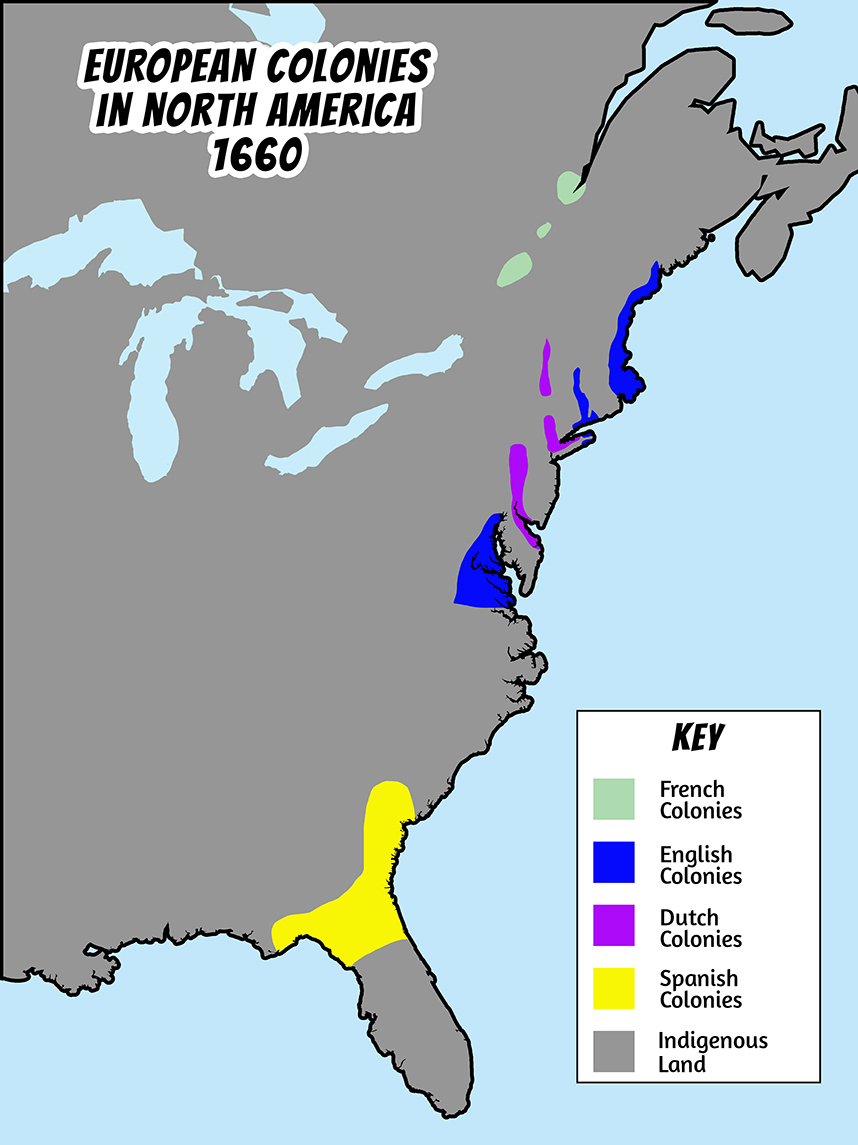
Britain captured the capital city of Nieuw-Amsterdam in 1664, soon renaming the city to New York after the King's brother, the Duke of York. Richard Nicolls, the military officer who led the expedition, was installed as the first governor of New York.
On 12 March 1664, King Charles II granted his brother James, Duke of York, all the land between Delaware River and Connecticut River.
Three months later, in a deed dated 24 June 1664, the Duke of York granted the land between the Hudson and Delaware rivers to John, Lord Berkeley and Sir George Carteret, both wealthy barons and members of the King's Privy Council. The deed states that this tract of land is to be named either New Caeserea or New Jersey.
Settlement of New Jersey
To entice more settlers, Berkeley and Carteret published the "Concession and Agreement", proclaiming religious freedom for all people living in the colony. This was done to try and increase the amont of quitrents (land tax) earned between the two, as more people would come into the colony.
However, many people living in New Jersey claimed that their land was received from Richard Nicolls, the governor of New York, and refused to pay quitrents to the two.
This financial difficulty drove Lord Berkeley to sell his interest in the western half of New Jersey to John Fenwick, on behalf of the bankrupt brewer Edward Byllynge, for £1,000 and an annual rent of beaver skins.
Biography
Early Life
George Elkington was baptised on 7 December 1650 in the village of Mollington, the son of Joseph Elkington and his wife, Anne. At a young age, George was apprenticed to Thomas Phipps, a blacksmith in the nearby parish of Shotteswell. In 1666, while an apprentice, George's uncle, William Elkington, passed away, bequeathing his house to George's elder brother Joseph; to pass to George if Joseph has no heirs.
After completing his apprenticeship, George worked as a blacksmith in St. James End, near the parish of Dallington in Northamptonshire and a few miles outside the city of Northampton. It's possible that George became a Quaker during this time -- the Quaker Meeting in Northampton was established in 1668.
George Elkington's first documented appearance is his baptism, recorded in the parish registers of Mollington, a small village in Oxfordshire. The entry reads: "George the son of Joseph Elkington & Anne his wife was baptized 7th of December 1650". He was one of seven children born to Joseph and Anne Elkington:
| Children born to Joseph & Anne Elkington | |
|---|---|
| Joseph Elkington | 3 August 1647 |
| George Elkington | 7 December 1650 |
| Elizabeth Elkington | January 1653 |
| Mary Elkington | 31 March 1661 |
| Richard Elkington | 5 April 1663 |
| William Elkington | ??? |
| Ann Elkington | ??? |
After George's death, his neighbour and close friend, Daniel Wills Jr. testified about his early life.
He this affirmant well knew and was acquainted with one George Elkinton born in Mollington in Warwickshire or Oxfordshire whose ffather's Name was Joseph Elkinton, a Dweller in the same Town of Mollington. This affirmant says he remembers that the said George Elkinton at a suitable age was put out an apprentice to one Thomas Phipps of Shatwell or Satchwell who was by trade a Blacksmith, a maker of edge Tools, & also made at some Times Smith's anvils.
The parish mentioned in this testimony is likely the parish of Shotteswell, only two miles away from Mollington. In that village's parish registers, there is a baptism entry for a Thomas Phipps, dated 13 July 1634. Likewise, the 1670 Hearth Tax for Shotteswell Parish mentions a Tho. Phipps with two forges, likely for smithing.
Though we can't take Daniel Wills' testimony at face value, the documented existence of this Thomas Phipps does boost his credibility.